Specialities
 Services
 Resource Center
 Pricing
 About
About
 Contact
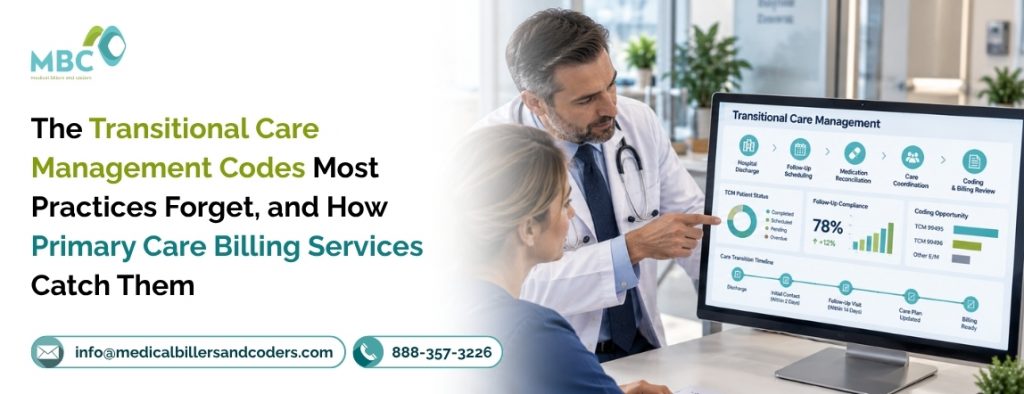
Most primary care groups forget the reimbursement tied to Transitional Care Management Codes CPT 99495 and 99496 because Transitional Care Management runs on a strict post-discharge clock, and the required patient contact window closes before front-desk staff even see the hospital discharge summary.
What Actually Qualifies as Billable Transitional Care Management Codes
Transitional Care Management covers the 30-day period after a patient leaves a hospital, observation stay, or skilled nursing facility for the community. To bill it, a practice needs three things on record.
Interactive contact with the patient or caregiver within 2 business days of discharge, by phone, secure message, or in person. A face-to-face visit within 7 calendar days for high-complexity cases (99496) or 14 calendar days for moderate-complexity cases (99495). And documented non-face-to-face care management, such as medication reconciliation, referral coordination, or caregiver education, delivered across the full 30-day period.
Only one provider can bill TCM per patient per 30-day period, and the code cannot be reported until that period closes, per CMS’s Transitional Care Management Services guidance.
Getting these three requirements on record consistently is exactly the kind of detail that specialized medical billing services are built to track, so nothing falls through between the discharge summary and the claim.
Three Forces Driving the TCM Revenue Gap
Discharge data arrives too late. Hospital discharge summaries often reach a primary care inbox 3 to 5 days after the event, past the 2-business-day contact deadline that both codes require.
Front desk books a standard follow-up instead of a TCM visit. Without a flag on the schedule, the visit gets coded as a routine office visit, and the higher-value TCM code is never captured.
Documentation doesn’t support the complexity level billed. Coders without training on these Transitional Care Management Codes frequently downcode 99496 to 99495, or drop the claim to a standard evaluation and management visit when the medical decision-making isn’t clearly documented.
Fixing these three failure points in isolation rarely holds; it takes coordinated RCM services that connect discharge alerts, scheduling, and coding review into one accountable workflow.
How Primary Care Billing Services Catch the Gap
A primary care revenue cycle team built for TCM closes this gap with three connected steps: a discharge data feed from hospital and SNF partners that flags TCM-eligible patients within hours of discharge, a scheduling protocol that reserves same-week slots for the 7-day and 14-day windows, and coding review that confirms medical decision-making complexity against payer documentation standards before the claim goes out.
For a ten-provider primary care group discharging 30 TCM-eligible patients each month, misreporting these Transitional Care Management Codes as a standard follow-up instead of 99495 or 99496 can cost more than $64,000 in lost reimbursement every 12 months.
This is why more multi-provider groups are turning to dedicated primary care billing services rather than asking front-desk staff to catch a 2-business-day deadline on top of their regular workload.
Transitional Care Management Codes: CPT 99495 vs. CPT 99496
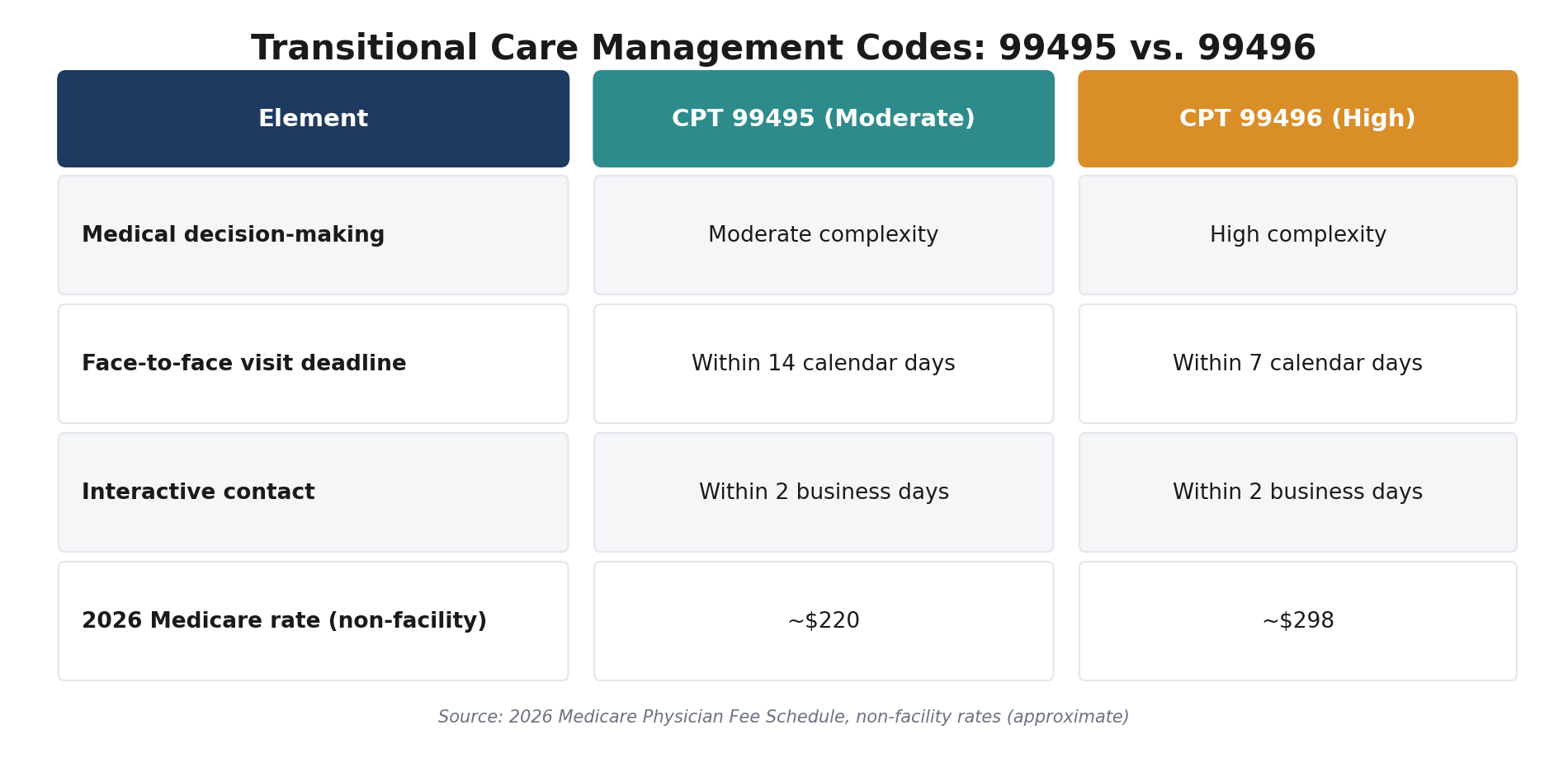
The table below breaks down the two Transitional Care Management Codes side by side, including the 2026 Medicare reimbursement difference.
| Element | CPT 99495 (Moderate Complexity) | CPT 99496 (High Complexity) |
| Medical decision-making | Moderate complexity | High complexity |
| Face-to-face visit deadline | Within 14 calendar days | Within 7 calendar days |
| Interactive contact | Within 2 business days | Within 2 business days |
| Service period | 30 days from discharge | 30 days from discharge |
| 2026 Medicare national rate (non-facility) | Approximately $220 | Approximately $298 |
Because the reimbursement gap between a missed TCM code and a standard follow-up visit is significant, practices comparing outside help should also look closely at a vendor’s medical billing pricing structure, since flat-fee and percentage-of-collections models reward TCM capture differently.
Common Transitional Care Management Codes Denial Triggers and Fixes
Left uncorrected, these patterns turn into recurring claim denials that cost more in appeals and rework than they would have taken to prevent at the point of coding.
| Denial Trigger | Root Cause | Fix |
| No documentation of interactive contact | Contact logged in a scheduling system, not the chart | Require contact date and method in the clinical note |
| Visit billed as standard E/M | No TCM flag on the schedule | Tag TCM-eligible patients at intake from the discharge feed |
| MDM level not supported | Documentation doesn’t match complexity billed | Coder review against payer MDM criteria before submission |
| Claim submitted before day 30 | TCM billed on the visit date instead of period close | Hold claim until the 30-day service period ends |
| Two providers bill TCM for one patient | No handoff protocol between referring and receiving providers | Confirm single-provider assignment before claim submission |
A structured denial management process — one that tracks root causes instead of just resubmitting claims — is what keeps a practice’s TCM capture rate from sliding back down over time.
Key Takeaways for Transitional Care Management Codes
- As the two Transitional Care Management Codes, CPT 99495 and 99496 both require interactive contact within 2 business days of discharge, a strict deadline most practices miss without a discharge data feed.
- The face-to-face visit window, 14 days for moderate complexity and 7 days for high complexity, decides which code applies and how much the visit is worth.
- Multi-provider primary care groups lose revenue when discharge data arrives late, visits get booked as standard follow-ups, or documentation doesn’t support the MDM level billed.
- A 2026 Medicare non-facility rate of approximately $298 for 99496 versus a standard follow-up visit makes TCM one of the highest-value codes a primary care group can capture and one of the easiest to lose.
MBC Spotlight
MBC’s Primary Care Center of Excellence runs a discharge-to-claim workflow built specifically for the TCM timeline: automated discharge alerts, same-week scheduling protocols for the 7-day and 14-day windows, and coding review that verifies medical decision-making documentation before submission. Clients on this workflow see a 97% clean claim rate and a 30% reduction in Days in AR within 90 days, backed by 25+ years of specialty-specific coding experience and a 98% client retention rate.
Request a Primary Care Revenue Diagnostic to find out how many TCM-eligible discharges your group is currently coding as standard follow-up visits.
Practices still weighing whether to build this in-house can see how the tradeoffs typically play out in this comparison of in-house billing versus outsourced revenue cycle management.
Source: Centers for Medicare & Medicaid Services (CMS), Transitional Care Management Services (MLN908628).
FAQs
As the two Transitional Care Management Codes, CPT 99495 covers moderate-complexity Transitional Care Management with a face-to-face visit required within 14 calendar days of discharge. CPT 99496 covers high-complexity TCM with a 7-day face-to-face requirement. Both require interactive patient contact within 2 business days and cover the same 30-day service period.
No. Medicare does not allow TCM and CCM to be billed for the same patient during the same 30-day period. Practices need a workflow that checks for an open TCM period before starting or continuing CCM billing to avoid a denial.
The billing provider, clinical staff acting under their direction, or qualified auxiliary personnel can complete the interactive contact, provided it happens within 2 business days of discharge and the method and content are documented in the chart.
The visit no longer qualifies for CPT 99495 or 99496. The practice can still bill a standard evaluation and management code for the visit, but the higher TCM reimbursement is lost for that discharge event.
Yes. TCM applies to discharges from an inpatient hospital, observation stay, or skilled nursing facility back to the community. Discharges to another inpatient facility do not qualify.

A Subject Matter Expert in healthcare billing operations with nearly 10 years of experience, sharing insights on claims processing, coding support, and revenue cycle optimization. Dedicated to educating healthcare professionals on compliance, accuracy, and strategies to improve billing performance.