Specialities
 Services
 Resource Center
 Pricing
 About
About
 Contact
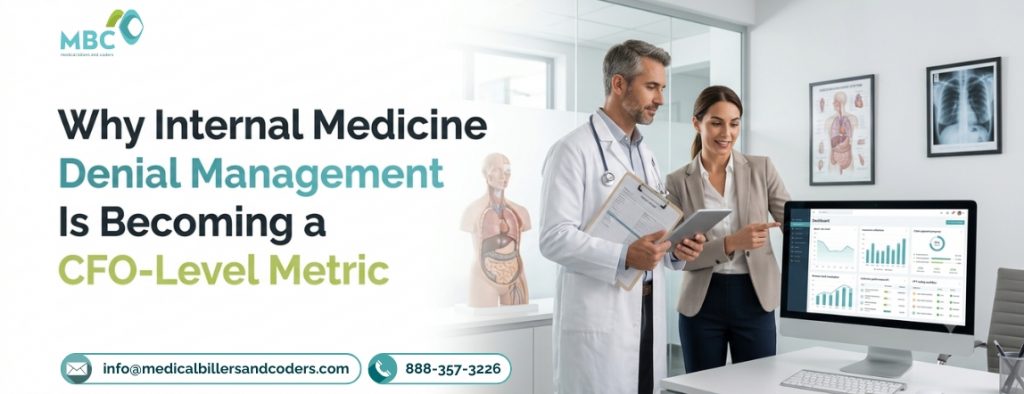
Internal Medicine Denial Management has moved off the billing floor and onto the CFO’s dashboard because unresolved denials now sit directly on top of practice EBITDA, not buried in a monthly claims report.
What Is Internal Medicine Denial Management?
Internal Medicine Denial Management is the structured process of identifying, correcting, appealing, and preventing insurance claim denials across the high-volume E/M visits, chronic care management, and preventive service codes that define internal medicine practices.
Unlike single-procedure specialties, internal medicine bills on documentation depth. Payers deny based on medical decision-making (MDM) level, comorbidity linkage, and care-management time thresholds — not just missing modifiers.
That complexity is exactly why denial patterns in internal medicine compound quietly across thousands of monthly encounters instead of showing up as one large loss.
The Triple Threat to Internal Medicine Margins
Each of these threats erodes Yield EBITDA quietly, one encounter at a time, long before the loss shows up as a line item.
1. E/M Downcoding and MDM Disputes Payers routinely challenge high-complexity E/M levels on chronic disease visits, forcing practices into either costly appeals or silent revenue write-offs.
2. Chronic and Transitional Care Management Denials CCM, TCM, and Annual Wellness Visit claims carry strict time and documentation rules that generic billing teams frequently miss, triggering recurring denials on recurring revenue.
3. Preventive Service and Medical Necessity Gaps Preventive codes billed alongside problem-focused visits often trigger diagnosis-linkage denials that require precise ICD-10 pairing to resolve.
Each of these threats behaves differently by payer, which is why practices need Internal Medicine Billing Services built specifically around this documentation-intensive specialty.
Why This Became a CFO-Level Metric
Denial rate used to be a back-office KPI. For multi-provider internal medicine groups, it now determines cash flow predictability, valuation multiples, and the pace at which old AR recovery work has to happen just to stabilize collections.
This is why Enterprise Revenue Integrity has replaced denial rate as the metric CFOs actually track. It measures how much of a claim’s full value converts into net realized revenue, not just whether the claim was paid.
According to MGMA, the median AR aged past 120 days sits at 13.54 percent across practices — a benchmark that CFOs at PE-backed platforms now track quarter over quarter. HFMA sets the target for AR over 90 days below 10 percent for a well-run revenue cycle.
When internal medicine denial rates drift above those benchmarks, the effect is not isolated to one claim. It compounds across every provider, every payer contract, and every reporting period.
[Editorial note: insert an approved internal-medicine-specific dollar-loss figure here once confirmed — e.g., “a multi-provider group averaging $X in monthly collections typically leaves $Y on the table per 12 months to denial-driven leakage.” Not included above since no approved figure exists yet.]
Table 1: Common Internal Medicine Denial Triggers
| Denial Trigger | Root Cause | Typical Impact |
|---|---|---|
| E/M level downcoding | Insufficient MDM documentation | Reduced per-visit reimbursement |
| CCM/TCM claim rejection | Time or consent documentation gaps | Lost recurring monthly revenue |
| Preventive vs. problem-focused conflict | Improper modifier or diagnosis pairing | Full claim denial |
| Medical necessity denial | Diagnosis-to-service mismatch | Delayed or written-off payment |
| Timely filing denial | Backlogged claim submission | Permanent revenue loss |
Table 2: Internal Medicine RCM Benchmarks
| Metric | Industry Benchmark | Source |
|---|---|---|
| AR aged past 120 days | 13.54% median | MGMA |
| AR aged past 90 days | Under 10% target | HFMA |
| Clean claim rate (MBC clients) | 97% | MBC internal data |
| A/R reduction within 90 days (MBC clients) | 30% | MBC internal data |
Why the Right Billing Partner Changes the Outcome
Generic Medical Billing Services apply the same denial workflow across every specialty, which is precisely where internal medicine practices lose ground. Chronic disease coding, care-management billing, and preventive service rules require Denial Management protocols built for this specialty, not adapted from surgical or procedural billing models.
A dedicated account manager who understands Revenue Cycle Management (RCM) at the internal medicine level applies denial root-cause engineering rather than one-off appeals — tracing each claim denial back to the payer policy, MDM gap, or documentation habit driving it.
Payer variance detection matters just as much. The same E/M code can be reimbursed and denied differently across Medicare, Medicaid managed care, and commercial payers, and a practice tracking only its overall denial rate will miss which specific contracts are bleeding revenue. This is the core of a working Revenue Integrity Framework: root causes get corrected once, not re-appealed every month.
Practices should also confirm their billing partner manages Credentialing proactively. Lapsed enrollments and expired payer contracts generate denials that have nothing to do with coding accuracy, yet they hit the same AR bucket.
Conclusion
Internal Medicine Denial Management has become a CFO-level metric because denial trends now directly shape cash flow forecasting, valuation conversations, and the operating leverage multi-provider groups need to scale. Practices that treat denial management as a back-office task, rather than a margin-protection discipline, will keep losing revenue quietly across every reporting cycle. The practices gaining ground are the ones pairing specialty-specific denial protocols with proactive credentialing and root-cause analysis, not generic claim rework. If your denial rate has not been reviewed against current benchmarks recently, that gap is worth quantifying before it grows further.
Request Your Revenue Diagnostic to see where your internal medicine denial rate stands against current benchmarks.
Frequently Asked Questions
It is the process of identifying, correcting, and preventing claim denials specific to internal medicine billing, including E/M downcoding, chronic care management rejections, and preventive service conflicts. Effective denial management combines root-cause analysis with specialty-specific coding protocols to reduce recurring losses across high-volume encounters.
Internal medicine bills on documentation depth rather than single procedures, so denials often stem from MDM-level disputes, missing care-management time documentation, or diagnosis-linkage errors. These issues recur across thousands of monthly encounters if the root cause is not corrected.
Rising denial rates increase AR aging, reduce predictable cash flow, and signal operational risk to PE-backed buyers or lenders. CFOs now track denial trends alongside collections because both directly affect EBITDA and valuation multiples during growth or acquisition conversations.
Most well-run revenue cycles target AR over 90 days below 10 percent, per HFMA guidance, and keep AR past 120 days well under the MGMA median of 13.54 percent. Practices exceeding these benchmarks should audit denial patterns by payer and code family.
Outsourcing makes sense when in-house teams cannot keep pace with payer-specific documentation rules for CCM, TCM, and E/M coding. A specialized partner brings denial root-cause analysis, credentialing oversight, and reporting that in-house teams handling multiple administrative tasks often cannot sustain.

A Subject Matter Expert in healthcare billing operations with nearly 10 years of experience, sharing insights on claims processing, coding support, and revenue cycle optimization. Dedicated to educating healthcare professionals on compliance, accuracy, and strategies to improve billing performance.