

 Specialities
 Services
 Resource Center
 Pricing
 About
About
 Contact
Key Takeaways
- For a primary care medical records service, AI medical scribes capture the patient visit and draft a structured note, but the provider remains the legal author and must review and sign every note.
- Real-world studies show moderate time savings, and primary care clinicians see some of the largest gains.
- Results depend on how consistently providers use the tool, so rollout and training matter as much as the software.
- Templated AI note language can trigger payer scrutiny, especially in Medicare Advantage, so every note must stay patient-specific.
- A signed BAA, a patient consent workflow, and direct EHR write-back are baseline requirements before adoption.
- An AI scribe covers one step of electronic health record management. Coding, HCC review, charge capture, and records workflows still need trained human teams.
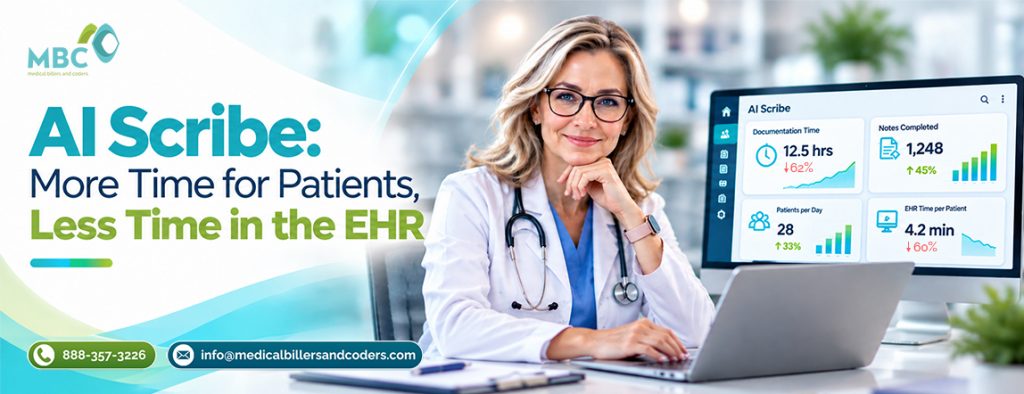
AI medical scribes support a primary care medical records service by drafting visit notes from the patient conversation, which providers then review, edit, and sign inside the EHR.
For multi-provider primary care groups, this matters because EHR documentation load grows with every chronic condition, annual wellness visit, and patient portal message.
What Are AI Medical Scribes?
AI medical scribes are software tools that listen to the clinical encounter, with patient consent, and convert the conversation into a draft clinical note. Most use ambient listening, so the provider talks with the patient normally instead of typing or dictating.
The draft usually follows a familiar structure: chief complaint, history of present illness, review of systems, exam findings, assessment, and plan. Many tools let practices set templates by visit type, such as a new patient visit, a chronic care follow-up, or a preventive exam.
AI scribes differ from human scribes in one important way. A human scribe can be trained to document with coding requirements in mind, while most AI tools focus only on capturing what was said. MBC covers this comparison in detail in its guide to medical scribing services for physician groups.
Why EHR Documentation Hits Primary Care Hardest
Primary care visits are rarely about one problem. A single follow-up may cover blood pressure control, a diabetes medication change, a new knee complaint, and a referral, and each item needs documented assessment and plan.
Primary care also carries a heavy share of preventive and longitudinal care. Annual wellness visits, chronic care management, transitional care, and care gap closure each come with their own documentation requirements, on top of standard office visits.
That workload continues after clinic hours. Inbox messages, refill requests, lab result notes, and prior authorization paperwork all add to EHR time, which is why documentation burden is a leading driver of after-hours charting in primary care.
Coding depends directly on this documentation. Since 2021, office visit E/M levels are based on medical decision-making or total time, so a note that misses complexity can lower the code billed, as explained in MBC’s guide to CPT code 99213 for established patient visits.
How AI Scribes Support Medical Records Service in Primary Care
The core value of AI scribes for EHR management is turning spoken clinical detail into an organized, readable record without the provider typing during the visit. That keeps attention on the patient and reduces the backlog of unfinished notes at the end of the day.
When the tool writes directly into structured EHR fields, the note lands where coders, nurses, and covering providers expect to find it. This makes the medical record easier to search, easier to hand off, and more consistent across providers in the same group.
Many platforms also draft supporting documents. These include after-visit summaries for patients, referral letters to specialists, and patient instructions written in plain language.
Each of these outputs becomes part of the legal medical record. That means the same review standard applies to a referral letter as to the visit note itself.
For EHR documentation for primary care, the most useful tools handle multi-problem visits well. Practices should test how a scribe separates three or four problems into distinct assessments, since a blended paragraph makes coding and future chart review harder.
Reducing Documentation Workload: What the Research Shows
The research supports real benefit, though smaller than many vendor claims suggest. A study across five U.S. health systems tracked over two years found AI scribes linked to roughly 16 fewer minutes of documentation per day, a relative drop of about 10%.
Primary care clinicians saw the largest gains in that research, at about 25 fewer minutes of EHR time, along with advanced practice clinicians and female clinicians.
Usage depth made a major difference. Only 32% of users used the scribe in more than half their visits, and that group saw three times the time reduction of lighter users.
Controlled trials show more modest results. The first randomized trial of an ambient scribe, published in NEJM AI in 2025, found a 9.5% reduction in time spent in the note.
Simulated settings show larger effects. In a University of Toronto simulation, primary care physicians spent 69.1% less time documenting with an AI scribe, though total visit length did not change significantly.
The practical lesson for administrators is simple: the tool does not save time on its own. Training, templates built for primary care visit types, and steady provider adoption drive the results.
AI-Generated Documentation and EHR Workflows: Why Provider Review Matters
AI-generated documentation supports EHR workflows only when a clinician verifies it. The clinician is the legal author of the record and must review, edit, and attest to the note before it becomes part of the chart.
AI tools can misattribute statements, miss negatives, or add details that were not discussed. A quick skim before signing does not catch these errors, so practices should set clear review expectations for every provider.
Review also protects revenue. Medicare Advantage plan review tools can detect near-identical language across encounters, including templated AI scribe phrasing, and may downcode or deny the E/M level as a result.
Risk adjustment adds another layer for primary care groups with large Medicare Advantage panels. Under the HCC V28 model, each chronic condition needs MEAT support and the right specificity to count, as covered in MBC’s guide to HCC V28 coding and risk scores.
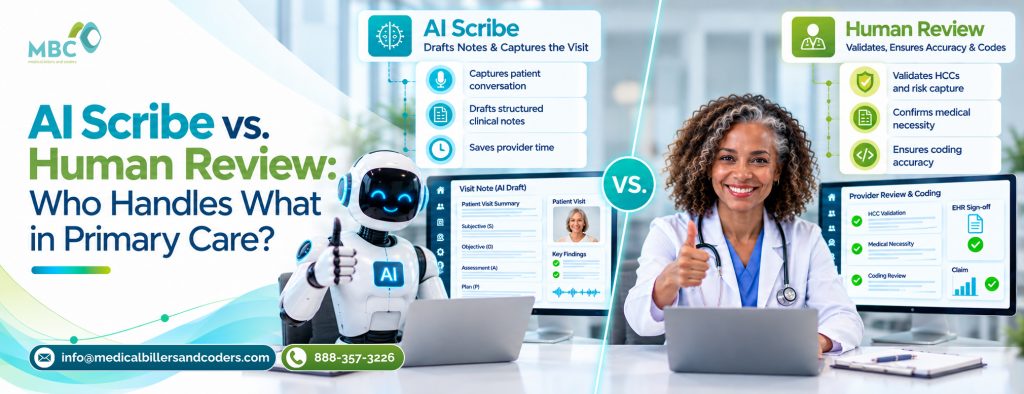
Regulators are also watching how AI shapes diagnoses. HHS-OIG’s February 2026 Medicare Advantage compliance guidance flagged AI-generated EHR prompts used to add risk-adjusting diagnoses as a potentially abusive practice and stressed that human review must be meaningful. MBC explains this balance in its article on AI vs human medical coders.
Benefits of AI Medical Scribes for a Primary Care Medical Records Service
Used well, AI medical scribes bring practical benefits across the practice. The gains are workflow and quality improvements, not a replacement for clinical or coding judgment.
Documentation efficiency. Providers start from a draft instead of a blank note. This shortens note completion time and reduces the number of open charts carried into the evening.
Improved clinician focus. With less typing during the visit, providers can maintain eye contact and conversation. One observational study found a 15.0% drop in documentation time per consultation alongside a 10.6% increase in eye contact time.
More organized medical records. Consistent structure across providers makes notes easier for coders, care coordinators, and covering clinicians to read. That consistency also supports cleaner handoffs within multi-site groups. For a medical records service team, that structure cuts the time spent chasing missing details.
Workflow support. Drafted referral letters and after-visit summaries reduce repetitive tasks for providers and support staff. The result is less copy-and-paste work, which also lowers the risk of carrying forward outdated information.
Where AI Scribes Fit in Medical Records Service and Electronic Health Record Management
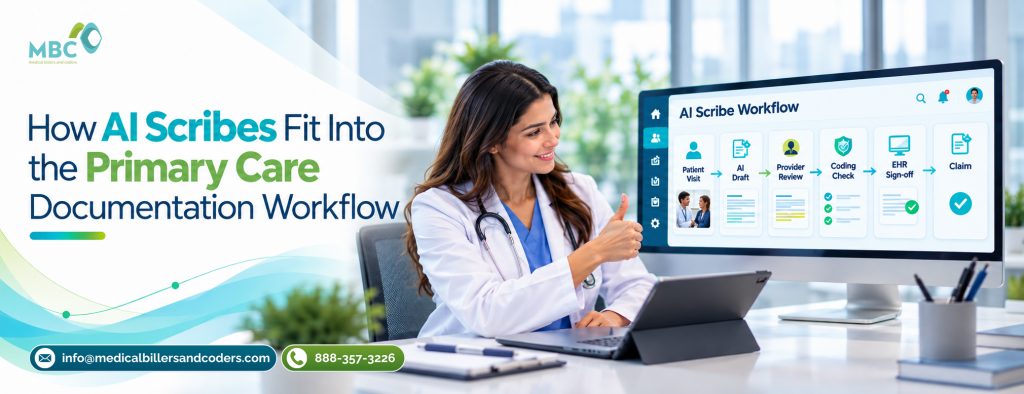
Electronic health record management for primary care covers far more than the visit note. Pre-visit chart prep, intake, coding, risk adjustment, charge capture, inbox management, and records requests all shape how complete and usable the record becomes.
An AI scribe strengthens one stage of that cycle. The table below shows where it helps and where trained staff remain essential.
| EHR Management Stage | What an AI Scribe Handles | What Still Needs a Trained Team |
|---|---|---|
| Pre-visit chart prep | Limited, depends on vendor | Care gap review, outside records, problem list updates |
| Visit documentation | Draft note from the conversation | Provider review, edits, and signature |
| E/M coding | Some tools suggest codes | Coder validation of MDM or time, modifier 25 use |
| HCC risk adjustment | Captures stated diagnoses | MEAT verification and ICD-10 specificity |
| AWV and CCM documentation | Partial capture of discussed elements | Checklist completion and time tracking |
| Charge capture and claims | Not covered | Charge entry, claim scrubbing, submission |
| Records requests and release | Not covered | HIPAA-compliant release and tracking |
The gaps in this table are where many practices lose time and revenue. A faster note helps only if the rest of the workflow is built to use it correctly. A dedicated medical records service closes those gaps so nothing falls between the AI draft and the final claim.
Key Considerations: Accuracy, Privacy, Security, Integration, and Compliance
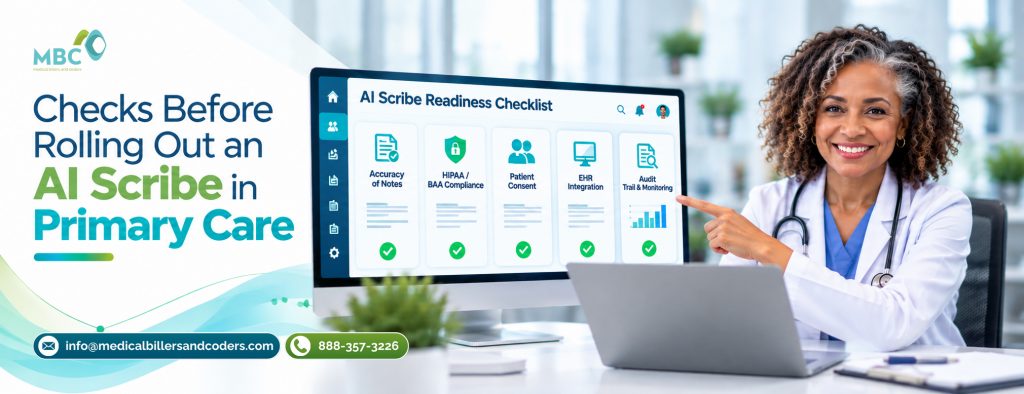
Choosing an AI scribe is a compliance decision as much as a technology decision. Governance guidance recommends treating an ambient scribe like any other AI system, with HIPAA mapping, consent handling, required human review, accuracy monitoring, and an audit trail.
Privacy and security. No tool is HIPAA compliant by default. The vendor handles PHI as a business associate, so a signed BAA and clear data retention terms are required.
Consumer tools are off limits. General chatbots, free transcription apps, and consumer note tools will not sign a BAA and should never process visit audio or transcripts.
Patient consent. Practices need a consistent consent script and a place in the record to document it, since recording without proper consent creates legal exposure.
Accuracy and equity. Note quality can vary by accent, language, and visit complexity. Practices should test the tool on real primary care scenarios before full rollout.
| Criterion | What to Confirm | Why It Matters |
|---|---|---|
| BAA and PHI handling | Signed BAA, storage location, retention terms | Required under HIPAA for any vendor handling PHI |
| Patient consent | Standard script and documented consent | Reduces legal exposure from recording |
| EHR integration | Direct write-back versus copy-paste | Copy-paste adds errors and staff time |
| Multi-problem accuracy | Separate assessment for each problem | Supports coding and future chart review |
| Coding support | Review layer for E/M and HCC accuracy | Faster notes do not guarantee correct codes |
| Audit trail | Record of who reviewed and signed each note | Supports compliance and payer audits |
Practical Steps for Rolling Out AI Scribes in Primary Care
A structured rollout helps practices see value faster, keeps the medical records service consistent across providers, and avoids documentation problems that surface later as denials.
- Measure your baseline. Record current note completion time, after-hours EHR time, and E/M level distribution by provider before launch.
- Start with a pilot group. Choose a few providers with different visit mixes, including chronic care and preventive visits.
- Build primary care templates. Set up templates for annual wellness visits, chronic care follow-ups, and acute visits.
- Set review standards. Define what every provider must check before signing, including medications, assessments, and plan details.
- Add coding review. Have coders audit a sample of AI-drafted notes for MDM support, HCC specificity, and repetitive language.
- Track results. Compare post-launch metrics against your baseline and adjust training based on what the data shows.
Step five is often skipped, and it is where documentation and revenue risk usually hide. Many groups use an outside coding and audit service to review AI-drafted notes during the pilot.
How MBC’s Medical Records Service Supports Primary Care Documentation and Revenue Workflow
An AI scribe speeds up the note. It does not confirm that the note supports the E/M level billed, that each chronic condition is coded to the right specificity, or that the claim leaves clean. That gap is where Medical Billers and Coders (MBC) works with multi-provider primary care groups.
MBC’s primary care billing services are built for high-volume primary care workflows, including Medicare, Medicaid, commercial payers, and value-based arrangements.
Our coders review AI-drafted and provider-written notes for MDM support, modifier 25 use on same-day preventive and problem visits, and ICD-10 specificity. Learn more about our medical coding services.
For practices in Medicare Advantage and value-based contracts, MBC reviews chronic condition documentation against risk adjustment requirements. Our HCC coding services help ensure documented diagnoses are supported and coded correctly.
When documentation issues show up as payer rejections, MBC applies denial root-cause engineering to fix the source, not just resubmit the claim. This approach is part of our broader revenue integrity framework.
Our model is system-agnostic, so it works inside the EHR your group already uses. Practices weighing their options can compare models in our guide to in-house vs outsourced primary care billing.
With 25+ years in revenue cycle management, MBC delivers a 97% clean claim rate and a 30% A/R reduction within 90 days for practices that move to our Revenue Integrity Framework, with a dedicated RCM Principal assigned to each client.
Request a Documentation-to-Reimbursement Audit to see, provider by provider, where AI-drafted or thin notes may be under-coding your primary care visits before they turn into denials.
FAQs
They can replace much of the typing, but not the judgment. AI scribes draft notes quickly, yet they do not validate coding, confirm medical necessity support, or verify HCC documentation. Many primary care groups pair an AI tool with coding-aware human review so faster notes also produce accurate claims.
A tool is not compliant by default. Compliance depends on a signed Business Associate Agreement, secure data storage, defined retention, and access controls. Practices should also document patient consent for recording and keep an audit trail showing who reviewed and signed each AI-drafted note.
Real-world multisite data points to about 16 fewer documentation minutes per day on average, with primary care seeing larger gains than most specialties. Results vary by how consistently providers use the tool, so practices should measure their own baseline before and after rollout.
They can. Repetitive, templated phrasing across patients may be flagged as cloned documentation by payer review systems, especially in Medicare Advantage. Providers should add patient-specific findings and medical decision-making to every note and avoid signing drafts without meaningful review.
Most major vendors integrate with Epic, athenahealth, eClinicalWorks, and other common systems, but integration depth varies. Confirm whether the tool writes directly into structured EHR fields or relies on copy-paste, since that difference affects staff workload and record accuracy.

A Subject Matter Expert in healthcare billing operations with nearly 10 years of experience, sharing insights on claims processing, coding support, and revenue cycle optimization. Dedicated to educating healthcare professionals on compliance, accuracy, and strategies to improve billing performance.
