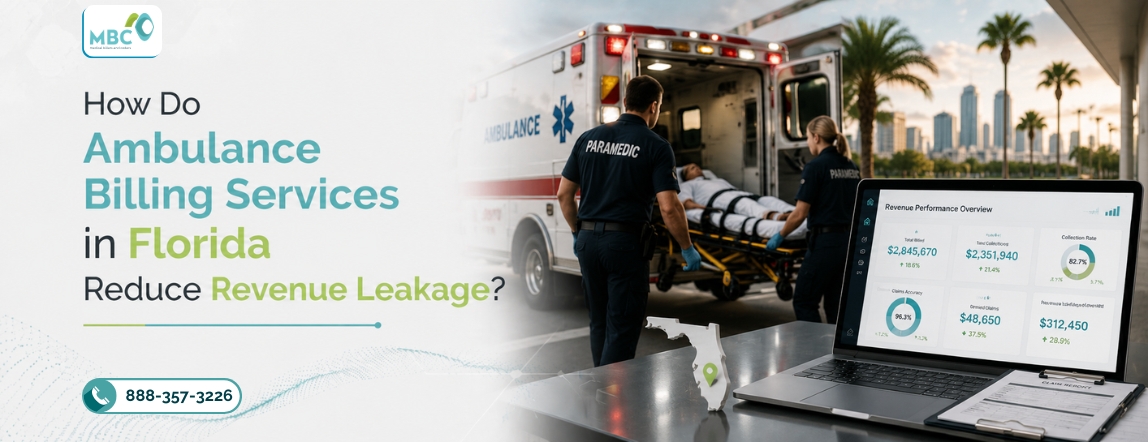
Ambulance Billing Services in Florida operate in one of the most complex payer environments in the country — and for EMS providers, that complexity translates directly into lost revenue.
Between Medicare’s Transport Indicator requirements, Medicaid’s Florida-specific prior authorization rules, and a commercial payer landscape that varies sharply by county, the margin for billing error is narrow.
For most EMS agencies and transport providers, the question isn’t whether revenue leakage exists — it’s how much, and where.
The answer demands more than basic medical billing services. It requires a specialized operational infrastructure built around EMS coding, trip documentation, and payer-specific denial patterns unique to Florida.
The Triple Threat to Florida EMS Revenue
1. Medical Necessity Documentation Gaps
Medicare reimburses ambulance transports only when the patient’s condition required emergency or non-emergency transport by ambulance — and the documentation in the Patient Care Report (PCR) must explicitly support that determination. Florida EMS providers lose significant revenue when PCR language fails to mirror the specificity CMS requires.
Phrases like “patient transported without incident” are claim killers. What the payer needs to see: why the patient couldn’t be transported by other means, the nature of the medical condition at the time of dispatch, and the crew’s clinical assessment.
MBC’s ambulance billing team audits PCR documentation against Medicare’s BLS and ALS transport criteria before submission, eliminating the most common root cause of medical necessity denials.
2. Incorrect Level-of-Service Coding
Florida EMS providers frequently face downcoding — payers reimbursing at BLS rates for transports that qualify as ALS1 or ALS2. The distinction between ALS1 (A0427) and ALS2 (A0433) depends entirely on the interventions documented during transport.
IV administration, cardiac monitoring, and medication delivery each carry specific coding thresholds. When trip sheets don’t capture these interventions in the required detail, revenue walks out the door.
Specialized ambulance billing services cross-reference PCR intervention data against current HCPCS coding guidelines, ensuring ALS transports are coded and billed at their correct acuity level — not downgraded due to documentation shortfalls.
3. Florida Medicaid Compliance Complexity
Florida Medicaid’s Non-Emergency Medical Transportation (NEMT) program operates under managed care plans with carrier-specific authorization requirements. Failing to obtain prior authorization, billing the wrong managed care organization, or misapplying Florida Medicaid’s transport modifier rules results in denials that often go unworked.
For high-volume transport providers, these denials compound rapidly. Agencies averaging 800+ transports per month can accumulate $40K–$80K in recoverable Medicaid revenue sitting in unworked denial queues.
How Specialized RCM Services Close the Gap
Generic medical billing vendors aren’t built for EMS. They lack the HCPCS expertise, the PCR auditing workflow, and the payer-specific denial logic that ambulance billing demands. RCM services purpose-built for the EMS sector deliver revenue recovery through four operational levers:
Real-Time Eligibility and Payer Verification
Before the claim is submitted, payer eligibility — including Medicare secondary coverage and Florida Medicaid managed care plan assignment — is verified against the transport date. This single step eliminates a significant portion of front-end rejections.
PCR-to-Claim Auditing
Every transport record is reviewed for medical necessity language, level-of-service alignment, and mileage accuracy before the claim goes out. MBC’s EMS billing teams have reduced clean claim failure rates by catching documentation gaps that payers would otherwise deny on first pass.
Denial Management with Root-Cause Tracking
Rather than just resubmitting denied claims, a high-performance denial management workflow identifies the payer-specific pattern driving the denial — and fixes it upstream. For Florida Ambulance Billing Services clients, this approach consistently accelerates Days in AR and increases Net Collection Ratio within the first 90 days.
Mileage and Origin/Destination Accuracy
CMS scrutinizes loaded mileage billing closely. Florida providers face particular exposure here because transport distances in rural counties can trigger additional review thresholds. Accurate origin and destination documentation — mapped against the transport address in the PCR — protects against post-payment audits.
What the Numbers Look Like
EMS agencies that transition to specialized Ambulance Billing Services in Florida typically see measurable gains within a billing cycle: first-pass acceptance rates improving from 78–82% to 94%+, Days in AR compressing by 15–20%, and previously written-off Medicaid denials recovered at recovery rates averaging 60–70% when worked within 60 days of the original denial.
For a mid-size Florida EMS provider running 600 transports per month, those gains translate to $150K–$300K in additional annual collections — revenue that was always earned, just never captured.
To understand what your agency’s current billing performance actually costs you, explore MBC’s transparent service structure before assuming your current setup is optimized.
Why Florida-Specific Expertise Matters
Ambulance Billing Services in Florida must navigate the state’s Medicaid expansion dynamics, CMS Zone Program Integrity Contractor (ZPIC) audit activity, and a commercial payer mix that includes Florida Blue, Humana, and United — each with distinct transport coverage policies. An RCM partner without Florida-specific payer intelligence is operating with an incomplete map.
MBC’s EMS billing specialists work exclusively within the Florida regulatory and payer framework, applying LCD-aligned documentation standards and managed care contract knowledge to protect your agency from both underpayment and audit exposure.
Email: info@medicalbillersandcoders.com
Phone: 888-357-3226
FAQs
Florida’s Medicaid managed care structure, NEMT authorization requirements, and ZPIC audit exposure create a payer environment that demands EMS-specific billing expertise beyond standard medical billing protocols.
Most agencies see a clear picture of denial root causes and undercoding patterns within the first 30–45 days of a billing audit.
Yes — MBC’s ambulance billing services cover BLS, ALS1, ALS2, and NEMT transports, including mileage billing and Florida Medicaid managed care submissions.
PCRs must document specific crew interventions during transport — IV access, medication administration, cardiac monitoring — aligned to CMS’s ALS threshold criteria for A0426, A0427, and A0433 billing.
In most cases, yes. Florida payers allow a 180-day window from the original denial to file a corrected claim or appeal, and MBC’s denial recovery teams routinely recover claims written off by prior billing vendors.
How Do Ambulance Billing Services in Florida Reduce Revenue Leakage?
Phone: 888-357-3226Email: sales@medicalbillersandcoders.com