Specialities
 Services
 Resource Center
 Pricing
 About
About
 Contact
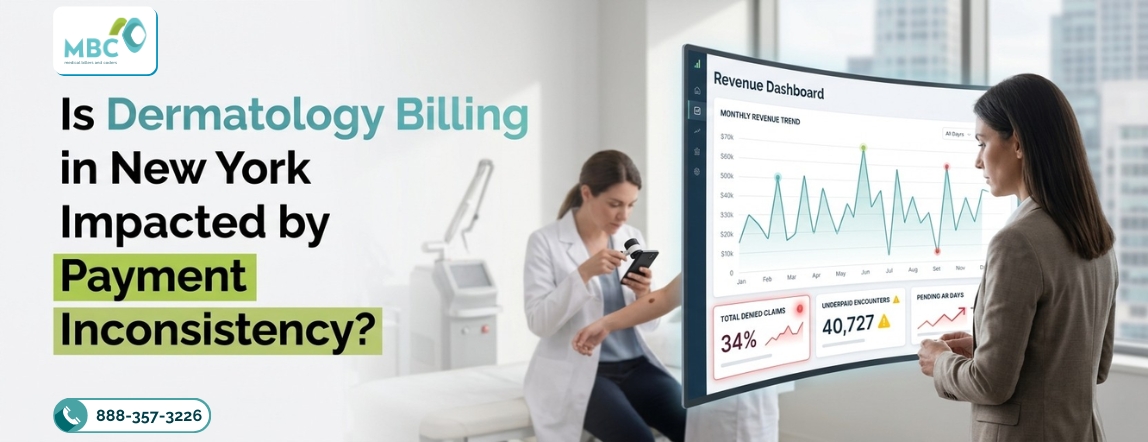
Yes — and for most New York dermatology practices, the inconsistency is structural, not incidental. Dermatology billing in New York operates across one of the most fragmented payer landscapes in the country. EmblemHealth, Healthfirst, Fidelis Care, MetroPlus, and Anthem Blue Cross each apply different reimbursement rules, modifier requirements, and medical-necessity definitions to the same dermatology procedures. The result is that the same biopsy, excision, or biologic administration generates materially different reimbursement — and different denial risks — depending on which plan covers the patient that day. Most practices absorb this variance as background noise without ever quantifying its cost.
The 2026 environment has made this worse. CMS applied a 2.5% efficiency adjustment to work RVUs on non-time-based services, which directly compresses reimbursement on high-volume dermatology procedure codes. New York’s commercial payers — many of which shadow Medicare’s fee schedule — have effectively passed this compression downstream. At the same time, AI-assisted claim review has accelerated at EmblemHealth, Anthem, and UnitedHealthcare, automatically flagging Modifier 25 claims where the E/M documentation shares language with the procedure note. New York dermatology practices also face the January 2026 GHI CBP replacement by NYCE PPO — a joint EmblemHealth and UnitedHealthcare product that replaces the previous City of New York employee plan — resulting in new plan IDs, new authorization workflows, and new claim submission requirements for a large portion of NYC-based patients.
Payment inconsistencies in dermatology billing services for New York practices typically appear in three areas. First, excision codes (11400–11646) are reimbursed at different rates by Fidelis and Healthfirst Medicaid plans than by commercial payers, and the documentation standards required to support the code level differ between them. Second, biologic prior authorization denial rates have reached 51% nationally in 2026, but in New York, Anthem and EmblemHealth impose the most restrictive step-therapy requirements of any commercial payers in the state. Third, Modifier 25 denials — where the E/M is bundled into the procedure because the clinical note did not establish a clearly separate medical decision — are generating systematic revenue loss at practices with high biopsy or cryotherapy volumes.
The fix for New York dermatology practices is not a single coding update. It is a payer-specific billing matrix that tracks what each major New York plan requires for documentation, modifiers, and prior authorization — and a claim scrubbing workflow that applies those requirements before submission, not after denial. Effective medical billing services in New York for dermatology are built around proactive payer variance detection, not reactive denial management.
MBC’s medical billing services include a no-cost Revenue Diagnostic that identifies exactly where your New York dermatology practice is losing revenue to payment inconsistency — by payer, procedure code, and denial pattern.
Payment inconsistencies in New York dermatology billing recur with each claim cycle until the payer-specific workflow is corrected. MBC’s Dermatology Billing Services fix the structural gaps — so your practice stops losing the same revenue month after month.
Frequently Asked Questions: Dermatology Billing in New York
Payment inconsistencies in dermatology billing in New York arise because each payer — EmblemHealth, Healthfirst, Fidelis Care, MetroPlus, Anthem, and UnitedHealthcare — maintains its own fee schedules, modifier rules, bundling logic, and medical-necessity definitions for dermatology procedures. The same excision or biopsy code generates different reimbursement and different denial risk depending on which plan covers the patient. New York Medicaid managed care plans also require specific modifiers that differ from commercial insurance guidelines, creating additional inconsistency when practices apply uniform billing rules across all payers.
Anthem Blue Cross and EmblemHealth apply the most aggressive AI-assisted claim review in New York for dermatology, specifically targeting Modifier 25 claims in which the E/M note contains language that overlaps with the procedure documentation. Healthfirst and Fidelis Care Medicaid plans impose strict frequency limits on lesion destruction codes and require specific diagnostic codes that differ from those of commercial payers. The January 2026 replacement of GHI CBP with NYCE PPO (a joint product of EmblemHealth and UnitedHealthcare) also created a new category of billing disruptions for NYC-based practices serving City of New York employees — new plan IDs, new portals, and new authorization workflows that practices had to update mid-cycle.
CMS applied a 2.5% efficiency adjustment to work RVUs on non-time-based services in 2026, directly compressing reimbursement on high-volume dermatology procedure codes — biopsies, excisions, lesion destructions, and cryotherapy. New York commercial payers that shadow Medicare’s fee schedule have effectively passed this reduction downstream. Combined with New York’s already competitive reimbursement environment, the 2026 MPFS adjustment means that dermatology practices in New York are collecting less per procedure, even when denial rates hold steady. Accurate medical billing services in New York that run payer-specific fee-schedule comparisons can identify where practices are being paid below contracted rates — a separate but equally significant source of revenue loss due to payment inconsistencies.
New York payers — particularly Anthem and EmblemHealth — require that the E/M portion of a same-day biopsy or procedure visit be documented in a clearly separate section of the clinical note, with its own chief complaint, focused history, examination, and medical decision-making, distinct from the procedure documentation. Notes where the E/M and procedural sections share language or where the E/M is framed as a brief pre-procedure assessment will fail AI-based review, and the E/M charge will be automatically bundled or denied. New York dermatology billing services that include pre-submission Modifier 25 audits catch this pattern before it reaches the payer — rather than identifying it only after a denial cycle has accumulated.
MBC’s medical billing services in New York for dermatology are built around a payer-specific billing matrix that tracks the documentation, modifier, prior authorization, and fee schedule requirements for each major New York plan — EmblemHealth, Anthem, Healthfirst, Fidelis, MetroPlus, and UnitedHealthcare. Rather than applying uniform billing rules across all payers, MBC applies plan-level protocols to claims before submission. This proactive approach — payer variance detection, pre-submission claim scrubbing, and denial root-cause analysis — systematically reduces payment inconsistencies rather than addressing individual denied claims after the fact. MBC’s Revenue Diagnostic identifies exactly where your New York dermatology practice is losing revenue across your specific payer mix, with no cost or commitment.
Wound Care Billing Services in New York: Maximizing ROI with Smart Billing
Phone: 888-357-3226Fax: 888-316-4566
Email: sales@medicalbillersandcoders.com

Catering to more than 40 specialties, Medical Billers and Coders (MBC) is proficient in handling services that range from revenue cycle management to ICD-10 testing solutions. The main goal of our organization is to assist physicians looking for billers and coders, at the same time help billing specialists looking for jobs, reach the right place.