Specialities
 Services
 Resource Center
 Pricing
 About
About
 Contact
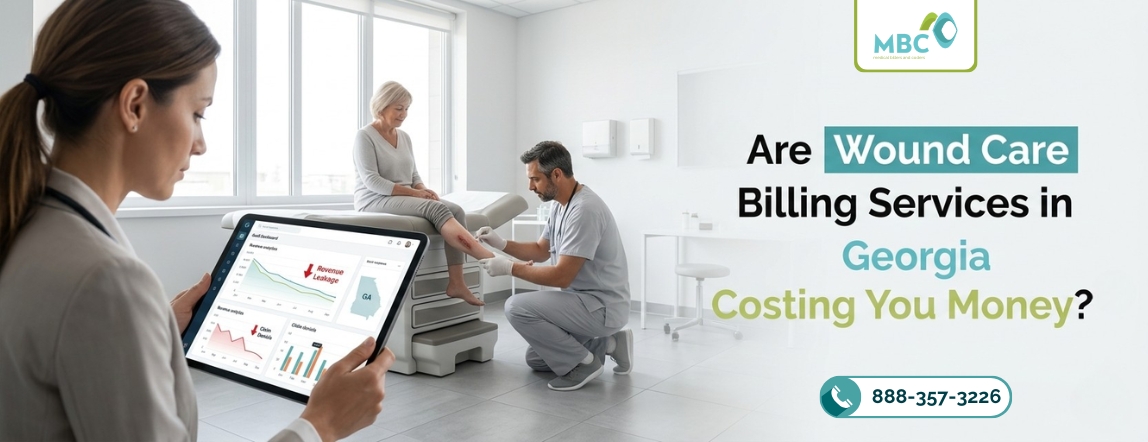
How Georgia Wound Care Facilities Are Losing $180K+ Annually to Revenue Leakage — and What High-Performance RCM Infrastructure Does Differently. If your facility relies on Wound Care Billing Services in Georgia and your collections have plateaued despite growing case volume, the problem isn’t your clinical outcomes — it’s your revenue cycle infrastructure.
Wound care is one of the most documentation-intensive, payer-sensitive specialties in outpatient medicine, and generic medical billing services built for primary care or orthopedics consistently mishandle the coding complexity that defines wound care reimbursement.
The result: chronic under-collection, audit exposure, and working capital gaps that force administrators to defer equipment purchases and expansion decisions.
The Three Revenue Threats Specific to Georgia Wound Care Facilities
Georgia’s wound care market operates under a unique convergence of pressures — Medicaid managed care expansion, aggressive CMS Local Coverage Determinations (LCDs) for advanced wound therapies, and a high concentration of rural Critical Access Hospitals managing complex chronic wound populations. Generic RCM services vendors don’t account for any of this.
Threat 1: LCD Non-Compliance on Advanced Wound Therapies
Medicare’s LCDs for skin substitutes, negative pressure wound therapy (NPWT), and hyperbaric oxygen (HBO) are among the most documentation-intensive coverage policies in outpatient billing.
A single missing element — failure to document wound dimensions at each encounter, insufficient prior conservative care notation, or an incorrect modifier on a multilayer compression system — triggers automatic denial.
For a facility billing 200+ wound care encounters monthly, this isn’t an occasional problem. It’s a systematic revenue leak averaging $12,000–$18,000 per month across mid-sized Georgia practices.
Threat 2: Skin Substitute Billing Without Manufacturer-Specific HCPCS Alignment
Wound Care Billing for skin substitutes is among the most volatile coding environments in outpatient medicine. CMS reassigns HCPCS codes for specific products quarterly, and payers in Georgia’s managed care environment — Amerigroup, Peach State Health Management, WellCare — apply their own coverage criteria independent of Medicare.
Facilities relying on non-specialized RCM services vendors are routinely billing discontinued codes or mismatching products to Q-codes, writing off an average of $2,800 per case in recoverable revenue.
Threat 3: Evaluation and Management Downcoding on Complex Chronic Wound Patients
Wound care patients typically present with significant comorbidity burdens — diabetic foot ulcers with peripheral arterial disease, venous leg ulcers with cardiac comorbidities, pressure injuries in post-acute transfers.
These encounters support 99214 and 99215 billing with appropriate Medical Decision Making documentation. Most generic billing teams default to 99213 to avoid audit risk, leaving $45–$90 per encounter on the table across a high-volume wound care program.
What Specialized Wound Care Billing Services in Georgia Actually Deliver
High-performance Wound Care Billing Services in Georgia are built around three operational pillars that generic vendors simply don’t offer:
- LCD Compliance Infrastructure: Real-time documentation gap alerts integrated with your EHR, flagging missing wound measurement data, conservative care documentation, and prior authorization triggers before claims are submitted — not after denials are received.
- Skin Substitute Revenue Integrity: A dedicated product-to-HCPCS matching engine updated with every CMS quarterly release, cross-referenced against Georgia payer-specific formularies, ensuring every Advanced Wound Care product is billed to the correct code at the correct contracted rate.
- E/M Optimization Protocols: Structured documentation support enabling your clinicians to capture the full complexity of multi-comorbid wound care encounters — protecting 99214/99215 billing at the encounter level without increasing audit risk.
The financial impact is measurable: MBC’s wound care clients in comparable markets average a 19% improvement in Net Collection Ratio within 90 days of implementation, recovering an average of $180K annually in previously written-off revenue across mid-sized outpatient wound programs.
Why Georgia’s Medicaid Managed Care Environment Requires Specialist-Level RCM
Georgia’s Medicaid managed care structure — with multiple CMOs operating under the Georgia Families and Georgia Families 360 contracts — creates a payer environment where wound care coverage criteria diverge significantly from traditional Medicare LCDs.
Facilities using general-purpose medical billing services are applying Medicare coverage logic to Amerigroup or Peach State claims and absorbing the denials as “managed care write-offs” rather than identifying them as preventable billing errors.
Specialized wound care RCM infrastructure maps coverage criteria by payer, by product category, and by procedure type — then applies that logic at the claim level before submission. The result is a clean claim rate above 97% for advanced wound therapy claims, compared to the 82–86% industry average for facilities using generalist billing teams.
The Diagnostic: Is Your Current Wound Care Billing Leaking Revenue?
Before assuming your current vendor is performing adequately, run this five-point diagnostic against your last 90 days of claims data:
- Skin substitute denial rate above 8%? You’re billing outdated or mismatched HCPCS codes.
- E/M distribution weighted below 99213? Your documentation support is under-coding complex encounters.
- Days in AR above 38 for wound care claims? Payer-specific credentialing or prior auth bottlenecks are unresolved.
- HBO or NPWT write-off rate above 12%? LCD documentation gaps are being absorbed rather than corrected upstream.
- Skin substitute cost-to-charge ratio untracked? You’re likely absorbing implant-equivalent revenue leakage on high-dollar biological products.
Any two of these flags indicate that your current Wound Care Billing Services in Georgia vendor is costing you more than their fee — and that a 90-Day Facility Revenue Audit would identify recoverable revenue exceeding the cost of switching.
MBC’s Wound Care Center of Excellence: What Operational Infrastructure Looks Like
MBC’s Wound Care Billing operations are built on specialty-specific infrastructure that generic RCM vendors don’t offer:
- Wound-specific coder certification: AHIMA-credentialed coders with dedicated wound care specialty training, not general outpatient coders rotated across specialties.
- Real-time LCD monitoring: Automated tracking of CMS Local Coverage Determination updates affecting Georgia wound care providers, with immediate coding protocol updates.
- Payer-specific contract analytics: Active monitoring of Georgia managed care wound care coverage policies, prior authorization requirements, and skin substitute formularies by CMO.
- CFO-grade reporting: Wound-specific KPI dashboards tracking NCR by procedure category, denial root cause by payer, skin substitute revenue integrity metrics, and Days in AR by wound type — giving your leadership team the visibility to make capital and operational decisions with confidence.
The result: Wound Care Billing Services in Georgia clients working within MBC’s operational infrastructure average a 22% reduction in Days in AR and a 94–97% Net Collection Ratio within two billing cycles.
Request Your 90-Day Wound Care Revenue Diagnostic
If your wound care program is generating volume but not translating into margin, you’re likely absorbing preventable revenue leakage in skin substitutes, NPWT, or HBO claims.
MBC’s 90-Day Wound Care Revenue Diagnostic identifies exactly where revenue is being lost — and quantifies the recoverable dollars across your last 90 days of claims.
No commitment. Just data-driven visibility into what your current billing infrastructure is missing.
Schedule your CFO-level revenue review at medicalbillersandcoders.com or speak directly with our wound care RCM specialists.
FAQs
A: Wound care billing requires specialty-specific expertise in CMS LCD compliance for advanced wound therapies, quarterly HCPCS updates for skin substitutes, and Georgia managed care payer-specific coverage criteria. Generic medical billing services apply standard outpatient logic to a specialty where coding errors directly correspond to five-figure monthly revenue losses. Specialized wound care RCM infrastructure — including real-time documentation gap alerts and payer-specific contract analytics — is required to consistently achieve 94%+ Net Collection Ratios in this specialty.
A: Key indicators include: skin substitute denial rates above 8%, E/M distribution weighted below 99213, Days in AR exceeding 38 days for Wound Care Billing Services claims, HBO or NPWT write-off rates above 12%, and absence of real-time wound product cost-to-charge tracking. Any two of these flags indicate measurable revenue leakage attributable to billing infrastructure gaps — not payer behavior.
A: Georgia’s CMOs — Amerigroup, Peach State Health Management, and WellCare — apply wound care coverage criteria that diverge significantly from Medicare LCDs. Skin substitute formularies, prior authorization requirements, and NPWT coverage thresholds vary by plan and change annually. Facilities using non-specialized RCM services routinely apply Medicare logic to managed care claims, absorbing preventable denials as managed care write-offs rather than identifying and correcting the upstream billing error.
A: MBC’s wound care clients in comparable markets average $180K in annual recovered revenue from previously written-off skin substitute, NPWT, and HBO claims, combined with a 19% improvement in Net Collection Ratio within 90 days. For a facility billing $2M+ in annual wound care services, the revenue recovery from specialized Wound Care Billing infrastructure typically exceeds the cost of transition within the first billing cycle.
A: Ask for: (1) their clean claim rate specifically for advanced wound therapy claims — not general outpatient; (2) their process for tracking quarterly CMS HCPCS updates for skin substitutes; (3) their denial root-cause reporting by procedure category; (4) whether they have Georgia managed care payer-specific coverage mapping for wound therapies; and (5) whether their reporting gives your CFO real-time visibility into wound-specific KPIs. Any vendor without clear answers to all five is a generalist operating in a specialist environment — and your margin is absorbing the difference. For a comprehensive assessment of Wound Care Billing Services in Georgia, request MBC’s 90-Day Facility Revenue Diagnostic.
Are Wound Care Billing Services in Georgia Costing You Money?
Phone: 888-357-3226Email: sales@medicalbillersandcoders.com

Catering to more than 40 specialties, Medical Billers and Coders (MBC) is proficient in handling services that range from revenue cycle management to ICD-10 testing solutions. The main goal of our organization is to assist physicians looking for billers and coders, at the same time help billing specialists looking for jobs, reach the right place.