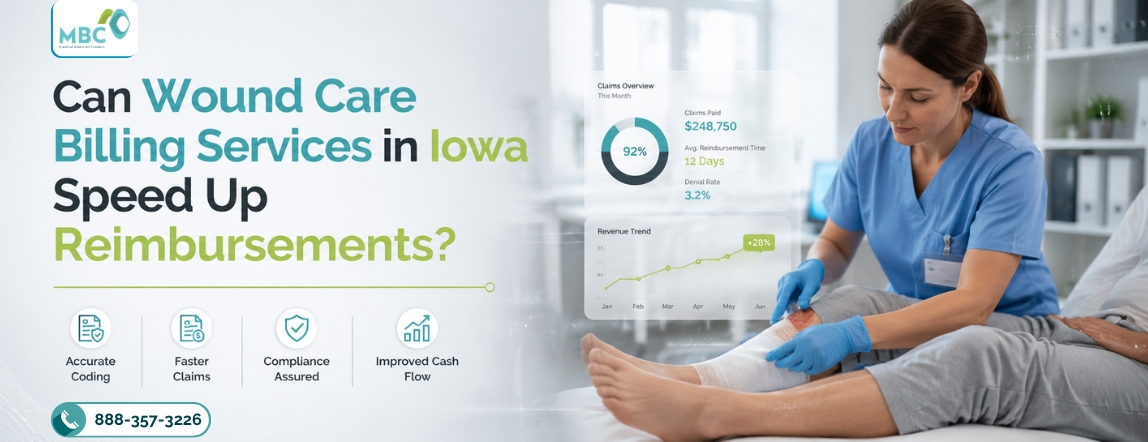
Wound Care Billing Services in Iowa are operating under mounting pressure — rural payer networks, LCD-dependent coverage determinations, and a growing chronic wound patient population that demands high documentation precision.
For Iowa wound care facilities managing chronic conditions like diabetic foot ulcers, venous stasis wounds, and post-surgical dehiscence, the gap between clinical excellence and reimbursement speed often comes down to one factor: the technical sophistication of your billing infrastructure.
The Iowa Payer Landscape Is Not Forgiving
Iowa’s payer mix creates specific AR acceleration challenges that generic medical billing services consistently underestimate. Medicare Advantage penetration across Iowa’s rural counties varies significantly by region, with payers applying LCD policies — particularly L33828 for debridement and L34898 for cellular and tissue-based products (CTPs) — with inconsistency that punishes facilities relying on manual claim review.
Wound care coders who don’t distinguish between selective debridement (CPT 97597) and non-selective debridement (CPT 97602), or who apply the wrong active wound care management codes (97598, 97605, 97606), create a cascade of denials that extend Days in AR well beyond the 30-day benchmark.
The result: facilities that should be collecting in 18 to 22 days are sitting at 45-plus, waiting on remittances that should have been clean the first time.
What Slows Wound Care Reimbursements in Iowa
Three operational gaps consistently delay reimbursements for Iowa wound care providers:
1. LCD Non-Compliance at the Documentation Level
CTPs like Apligraf and Dermagraft require specific documentation thresholds before payers will approve coverage — wound measurements, wound duration, prior treatment failures, and physician attestation. Iowa Medicare contractors enforce these requirements rigorously. Facilities that submit without meeting every criterion face automatic denials, triggering a 30 to 60-day appeals cycle that destroys cash flow predictability.
2. Modifier Misapplication on High-Dollar Procedures
Hyperbaric oxygen therapy (HBOT) — billed under CPT 99183 — requires accurate diagnosis linkage to ICD-10 codes like E11.621 (Type 2 diabetes with foot ulcer) or L97.509 (non-pressure chronic ulcer). Modifier errors or missing co-physician documentation routinely trigger Anthem, UnitedHealthcare, and Wellmark Blue Cross denials across Iowa markets.
3. Fragmented OR Log and Supply Capture
For wound care centers performing advanced procedures, unbilled supply costs — including negative pressure wound therapy (NPWT) units billed under A6550 or E2402 — represent significant revenue leakage. Iowa facilities relying on disconnected documentation workflows routinely miss billable supplies, leaving an average of $90,000 to $140,000 in annual revenue uncaptured.
How Specialized Wound Care Billing Services Accelerate Reimbursement
Wound Care Billing Services built specifically for this specialty deliver reimbursement velocity through three operational pillars:
Real-Time Eligibility and Prior Authorization Management
Iowa Medicaid and commercial payers require prior authorization for CTPs and HBOT. An RCM services infrastructure that automates authorization tracking — with payer-specific workflows for Wellmark, Molina Iowa, and Iowa Total Care — eliminates the administrative lag that turns clean clinical cases into 45-day AR problems.
CPT-Level Coding Accuracy with LCD Alignment
Specialized coders cross-reference every claim against the applicable LCD before submission. This means debridement claims are coded with the correct depth, surface area, and wound type — preventing the down-coding that costs Iowa facilities an estimated $1,200 to $2,800 per claim in lost reimbursement.
Denial Root-Cause Analytics
Unlike reactive denial management, enterprise Wound Care Billing Services use denial pattern analysis to identify upstream coding errors before they become systemic. Facilities that implement root-cause denial infrastructure reduce their denial rate from an industry average of 11% to under 4% within 90 days — directly compressing Days in AR.
The Iowa-Specific Compliance Dimension
Iowa wound care providers face OIG scrutiny on several fronts. The agency’s work plan consistently flags upcoded debridement levels, inappropriate CTP utilization, and HBOT overuse. Facilities without specialty-trained coders who understand the distinction between covered indications and investigational use under National Coverage Determination 270.1 are audit risks — regardless of clinical intent.
Wound Care Billing Services in Iowa that integrate compliance guardrails into the coding workflow — not as an afterthought, but as a front-end control — protect facilities from recoupment demands that can exceed $500,000 for multi-provider practices.
Why Iowa Facilities Are Rethinking Their RCM Partnerships
The shift from transactional billing to revenue performance management is accelerating in Iowa, particularly among wound care centers affiliated with hospital outpatient departments (HOPDs) and independent wound clinics competing for the same chronic patient population.
Facilities that partner with specialized Wound Care Billing Services in Iowa — rather than generalist billing vendors — report a 14% to 19% improvement in Net Collection Ratio within the first two quarters. For a facility collecting $2.5 million annually, that translates to $350,000 to $475,000 in additional recovered revenue.
If your Days in AR is trending above 35 and your clean claim rate is below 95%, the gap is almost certainly a coding infrastructure problem, not a payer problem.
To understand how billing performance directly impacts your facility’s financials, explore MBC’s transparent pricing and service tiers built for wound care revenue operations.
Wound Care Billing Services in Iowa that operate with specialty-specific coding protocols, real-time eligibility, and LCD-aligned documentation review don’t just process claims — they architect reimbursement velocity that rural and urban Iowa facilities depend on for operational sustainability.
Contact Medical Billers and Coders to schedule a facility yield audit: 888-357-3226 | info@medicalbillersandcoders.com
FAQs
Wound care billing requires LCD-specific documentation for CTPs, correct debridement CPT selection by depth and method, HBOT diagnosis linkage, and supply capture — complexity that generic medical billing services are not built to handle at the claim level.
Iowa’s payer mix — including Wellmark Blue Cross, Molina Iowa, and Iowa Total Care — applies LCD and prior authorization requirements inconsistently. Without payer-specific workflows, clean claims become denials, extending AR by 20 to 40 days unnecessarily.
CPT 97597, 97598, 97602, 99183, and the NPWT codes (A6550, E2402) are the most frequent sources of denial. Modifier misapplication on 97597 and 97598 alone accounts for significant revenue leakage in Iowa wound care facilities.
Facilities implementing specialty-specific Wound Care Billing Services in Iowa typically see Days in AR compress by 25% to 40% within 60 to 90 days, driven by clean claim rate improvement and denial pattern elimination.
Yes. MBC’s wound care billing infrastructure includes payer-specific prior authorization workflows for Iowa Medicaid, Medicare Advantage, and commercial payers — preventing the authorization lapses that convert billable procedures into write-offs.
Can Wound Care Billing Services in Iowa Speed Up Reimbursements?
Phone: 888-357-3226Email: sales@medicalbillersandcoders.com